
Commercial Roof Insulation: R-Value, Thickness and Cover Boards
Understand commercial roof insulation, R-value, cover boards and tapered layouts. Use a specification checklist to compare what roofing proposals include.
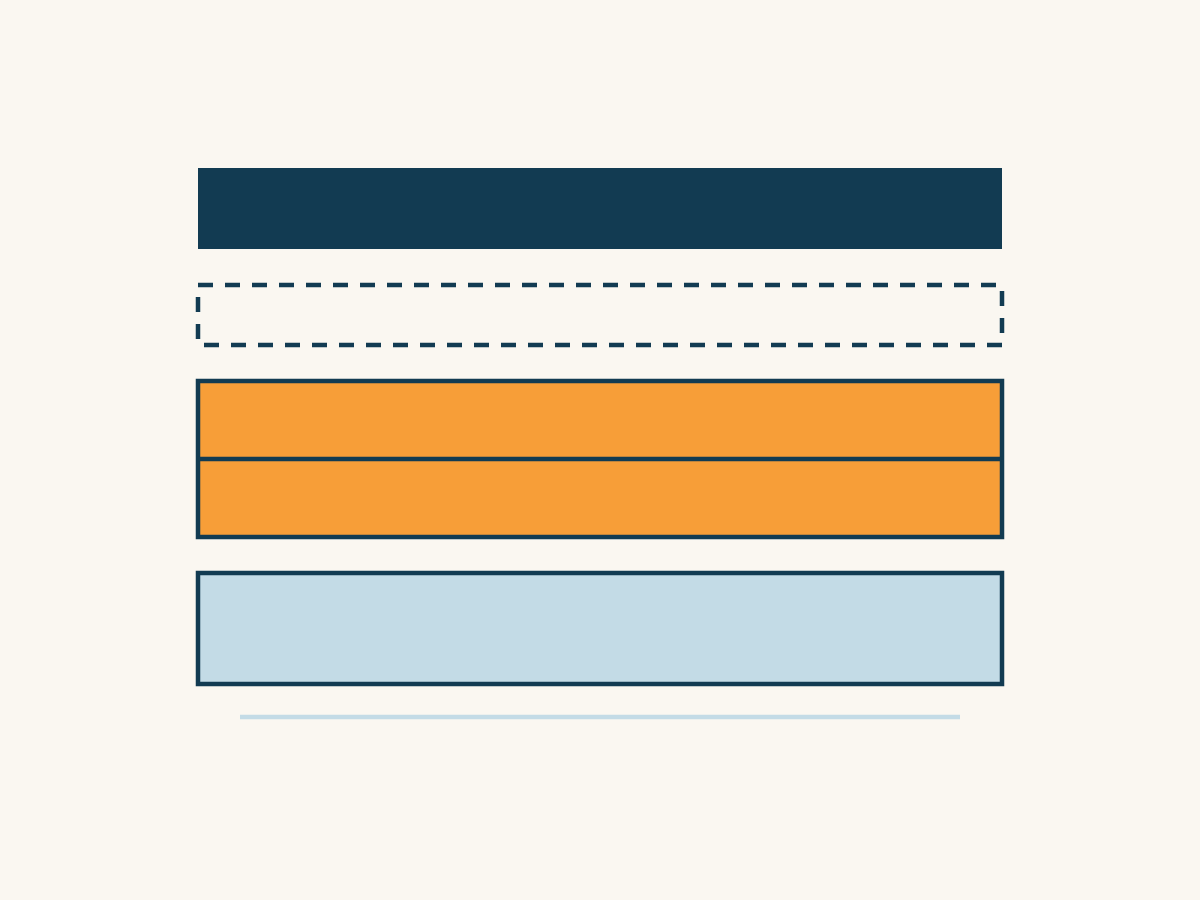
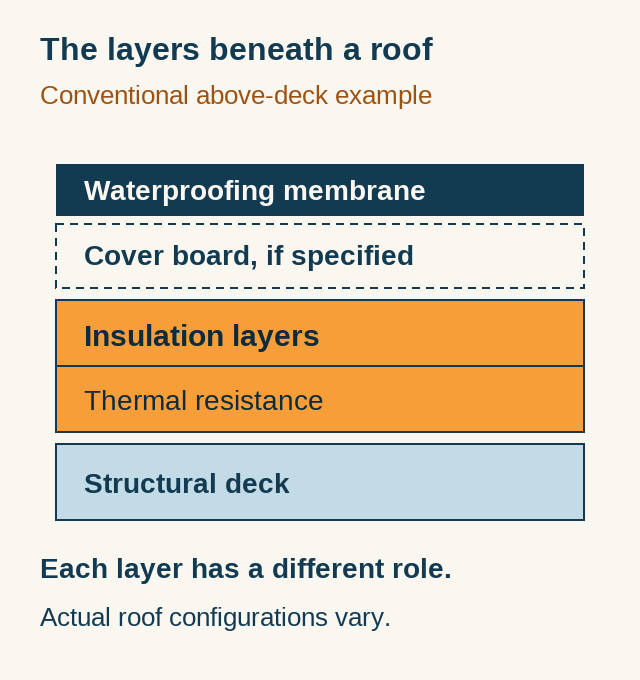
Conceptual roof layers; not an installation detail or a project-specific design.
Commercial roof insulation resists heat flow through the roof. To understand what a proposal provides, look beyond the material name: identify the product, thickness of each layer, published thermal resistance, attachment and the rest of the roof assembly.
Two proposals can name the same membrane while specifying different layers underneath it. The useful comparison is what each complete roof includes and why those details fit the building.
In this article
Where does insulation sit in the roof assembly?
In a conventional above-deck insulated roof, insulation sits above the structural deck and below the waterproofing membrane. A cover board may sit between the insulation and membrane. Other arrangements exist. Where a roof section drawing is available, use it to identify the layers rather than assuming every roof follows that order.
The layers have different jobs:
| Component | Main role | What to identify in a proposal |
|---|---|---|
| Structural deck | Supports the roof assembly and transfers loads to the structure | Deck type and the basis for judging its condition |
| Insulation | Provides thermal resistance | Named product, thickness, number of layers and published R-value |
| Cover board, where specified | Provides a surface for the roof covering and can protect underlying insulation | Product, thickness and role in the selected system |
| Membrane | Provides the roof's waterproofing layer | Product and method of attachment |
IKO's commercial insulation guide explains how insulation materials and their placement differ across roof systems. A component that works in one assembly is not automatically suitable in another.
Choosing the membrane is a separate question. The TPO, EPDM and modified-bitumen comparison covers those system tradeoffs.
What does an insulation R-value tell you?
R-value expresses resistance to heat flow under stated conditions. Thickness helps determine that resistance, but a generic material name and an inches figure are not enough to compare products. Use the manufacturer's published value for the specified product and thickness.
The reporting basis matters too. For example, GAF's polyiso explanation discusses long-term thermal resistance, or LTTR, for polyisocyanurate insulation. Other insulation products may use a different reporting basis, which should be identified on their own data sheets.
Ask whether the proposal's R-value describes an individual board, the insulation layers together or the performance basis used for the complete roof. Board joints, attachment and other assembly details also matter; a component value is not a forecast of the building's heating or cooling bill.
How do polyiso, EPS and XPS differ in a specification?
They are different rigid-foam insulation families, with product-specific properties and approved uses. Material selection needs to account for the membrane, attachment, moisture conditions and other assembly requirements, rather than a universal ranking.
| Family | What it is and where it can fit | What distinguishes the specification |
|---|---|---|
| Polyiso | Polyisocyanurate rigid foam board used as roof insulation; products can also be tapered to form slope | Identify the facer, thickness and published LTTR for the selected board |
| EPS | Expanded polystyrene, made from formed or molded beads; roof products include faced boards such as InsulFoam SP | Identify density, facing and the roof-system application approved for that product; some assemblies include a cover board or slip sheet |
| XPS | Extruded polystyrene, a closed-cell rigid foam; the FOAMULAR bulletin includes single-ply and protected-membrane roof applications | Identify the named product and assembly position, plus adhesive compatibility; protected-membrane use is one application, not its only use |
Polyiso proposals should identify the product and facer as well as thickness and thermal value. EPS proposals need the same specificity: the Versico InsulFoam SP bulletin distinguishes product properties and roof-system applications instead of approving every EPS board for every attachment method.
Likewise, the FOAMULAR XPS technical bulletin describes roofing applications and compatibility limits. An XPS label alone does not establish compatibility with a proposed adhesive or membrane.
The owner-level question is which documented assembly is being proposed, not which foam wins every comparison.
Is a cover board another layer of insulation?
A cover board has a different primary job, although a particular product may also contribute thermal resistance. Its properties need to be read separately from those of the insulation beneath it.
For example, GAF's EnergyGuard HD polyiso cover-board sheet identifies thermal and mechanical properties while describing the product as nonstructural. A board's strength rating does not replace structural evaluation of the roof.
Ask why the selected system includes a cover board, how it is attached and which installation and warranty documents apply. Do not assume every approved roof uses the same board or requires a separate board in every configuration.
Manufacturer-backed GAF warranty options can be part of that roofing specification. GAF lists Sundra as a GAF Certified Commercial Contractor, a designation that provides access to the GAF Integrated System Limited Warranty and System Pledge Roof Guarantee. For an eligible GAF roof, discuss the applicable warranty alongside the insulation, cover board and membrane specification. Our commercial roof warranty guide explains how to compare coverage with the proposed work.
What does tapered insulation change?
Tapered insulation varies in thickness to help form slope. That makes the roof layout important as well as the thermal specification: the proposal should show where water is intended to travel and how insulation thickness varies.
A tapered layout does not, by itself, establish why a roof ponds or whether drains and overflow provisions are adequate. Recurrent standing water belongs in a roof-drainage assessment, not a decision based solely on buying tapered boards.
What should an owner compare before agreeing to the scope?
Use the same fields to compare proposals. Some details may depend on a site assessment, design work or investigation of existing conditions, so clarify what is included at the current stage and what still needs to be established. This is a generic comparison worksheet, not a specification for your building.
| Field | Record for each proposal |
|---|---|
| Existing materials | What stays, what is removed and how condition is established |
| Insulation | Product and thickness of each layer |
| Thermal performance | Published R-values and the stated reporting/design basis |
| Cover board | Product, attachment and purpose, or the system basis for omitting one |
| Drainage | Layout drawing and relationship to drains and overflow provisions |
| Compliance | Applicable code edition and compliance path identified by the project team |
| Concealed conditions | How unexpected wet or damaged materials change the scope and price |
An assessment must establish whether existing materials are suitable to remain. The material name or a surface photograph cannot settle that question. For the proposed removal, replacement and installation scope, see commercial roof replacement.
Commercial roof insulation FAQs
Does thicker insulation always mean the better proposal?
Does thicker insulation always mean the better proposal?
No. Compare the specified thermal performance and complete assembly, including attachment, drainage and existing conditions. More thickness does not resolve an unsuitable product or an unresolved moisture problem.
Is there one minimum R-value for PA, NJ and DE roofs?
Is there one minimum R-value for PA, NJ and DE roofs?
Do not apply one number to every project. Ask the project team to identify the applicable adopted code, work category, compliance path and roof assembly. This guide does not prescribe a local code minimum.
Can the existing insulation be kept?
Can the existing insulation be kept?
That depends on its documented condition and suitability for the proposed work. Ask what was assessed, what remains uncertain and what happens if further investigation finds wet or damaged materials.
Sources
- IKO commercial insulation guide: material families, placement and roof-assembly context.
- GAF polyiso explanation: polyiso thermal reporting and assembly considerations.
- Versico InsulFoam SP bulletin: named EPS product properties and applications.
- FOAMULAR XPS bulletin: named XPS applications and compatibility limits.
- GAF EnergyGuard HD cover-board sheet: a product-specific example of cover-board properties and limitations.
- GAF commercial contractor listing for Sundra: Certified Commercial Contractor designation and the named warranty options available through that designation.
Related reading
- TPO vs. EPDM vs. Modified Bitumen: Comparing Commercial Roofing Systems
- Commercial Roof Warranties: What Is Actually Covered?